
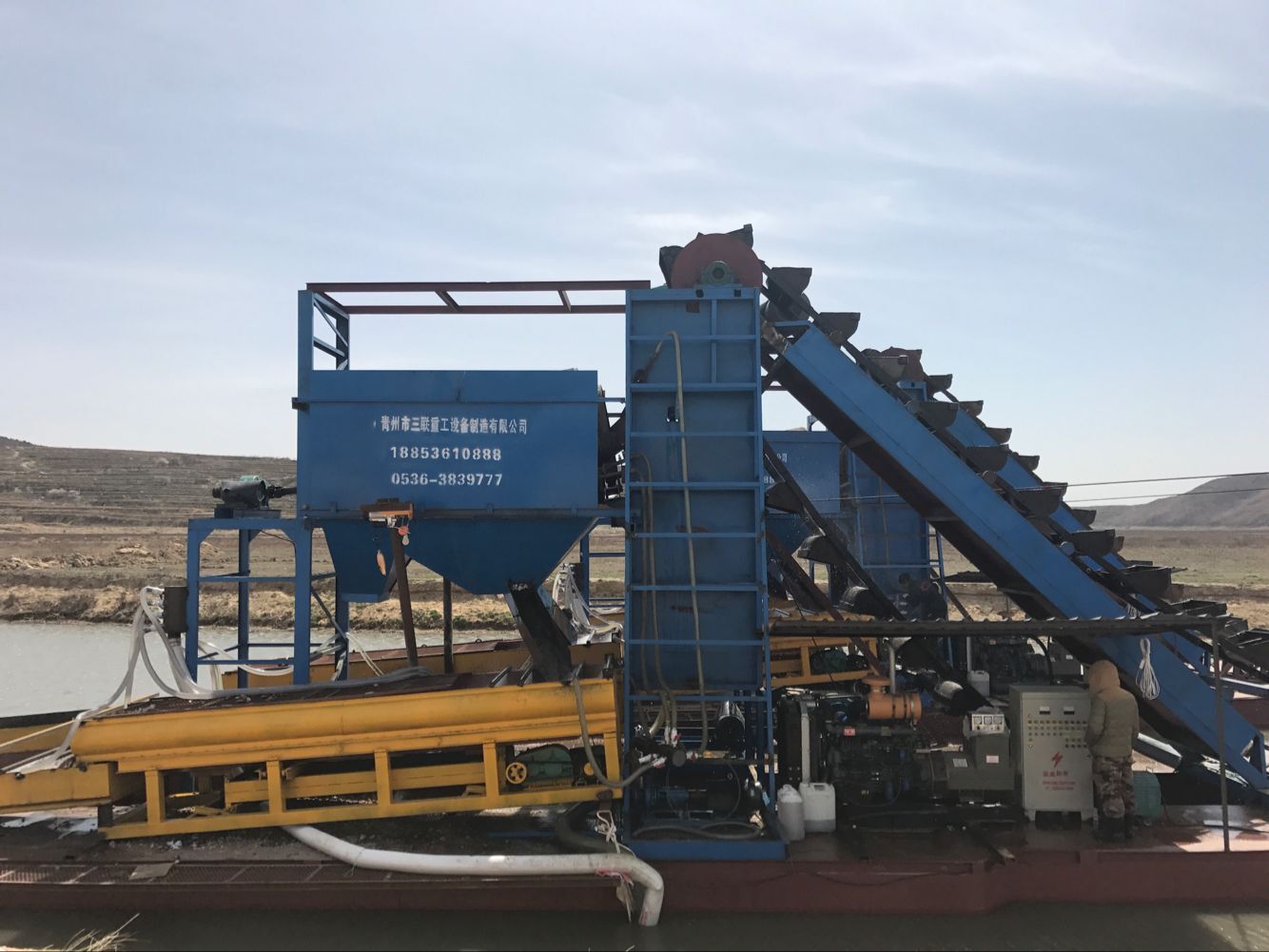
Choosing between a sand dredger and a gold dredger is a critical decision for your 2024 mining project—impacting efficiency, ROI, and operational scalability. Whether you're an operator assessing real-world performance, a decision-maker evaluating total cost of ownership, or a distributor seeking reliable equipment, understanding the functional differences between these two types of dredger is essential. Qingzhou Sanlian Heavy Industry, a leading R&D-driven manufacturer of professional dredging equipment, delivers high-performance sand dredger and gold dredger solutions engineered for durability, precision, and ease of maintenance. Let’s break down which dredger aligns best with your specific material, site conditions, and long-term goals.
Definition & Core Functional Distinction
A dredger is a specialized hydraulic excavation machine designed to extract, transport, and discharge sediment or mineral-bearing material from underwater or saturated environments. While both sand dredger and gold dredger fall under this broad category, their design philosophies diverge fundamentally. A sand dredger prioritizes high-volume throughput, robust wear resistance, and continuous operation in abrasive, low-value sediment matrices—common in riverbed reclamation, coastal nourishment, or aggregate production. In contrast, a gold dredger emphasizes fine-material recovery, gravity-based separation fidelity, and on-board concentration systems such as sluice boxes, jigs, or centrifugal concentrators. Its hydraulic circuitry is tuned for lower flow rates but higher pressure differentials to preserve gold particles during suction and minimize loss through turbulence. Crucially, neither unit is interchangeable without significant retrofitting: using a sand dredger for alluvial gold recovery often results in >35% fine-gold loss due to insufficient retention time and lack of integrated classification; deploying a gold dredger in large-scale sand extraction leads to premature pump clogging, excessive downtime, and unsustainable maintenance cycles. Qingzhou Sanlian Heavy Industry engineers each dredger platform from the ground up—starting with CFD-validated pump hydraulics, ISO 5801-compliant impeller dynamics, and ASTM A514 structural steel frames—to ensure purpose-built integrity, not repurposed adaptation.
Application Scenarios & Site-Specific Suitability
Real-world deployment reveals stark divergence in optimal use cases. Sand dredger units excel in regulated civil infrastructure projects: replenishing eroded shorelines (e.g., Guangdong Pearl River Delta restoration), supplying construction-grade sand to precast concrete plants, or clearing silted irrigation canals in arid agricultural zones. These applications demand sustained output (≥1,200 m³/h), tolerance to gravel up to 80 mm, and compliance with China’s GB/T 25609–2010 environmental discharge standards for turbidity control. Gold dredger systems, however, dominate artisanal and small-to-mid-scale alluvial operations—particularly in Yunnan’s Jinsha River basin, Inner Mongolia’s Erguna River tributaries, or overseas markets like Ghana’s Offin River concessions. Here, operators require modular mobility (often trailer-mounted or barge-integrated), adjustable draft (0.6–1.8 m), and real-time grade monitoring via integrated XRF analyzers. Critically, Qingzhou Sanlian’s gold dredger series includes patented dual-stage screening (12 mm primary + 0.8 mm secondary) paired with variable-frequency drives that auto-adjust suction velocity based on real-time slurry density feedback—reducing gold loss by up to 22% compared to fixed-speed competitors. For hybrid sites—such as gold-rich sand deposits requiring bulk removal followed by enrichment—our dual-mode dredger platforms offer field-swappable pump assemblies and plug-and-play concentrator interfaces, bridging operational gaps without capital duplication.
Technical Performance & Maintenance Intelligence
Performance metrics must be evaluated beyond nominal capacity. A comparative analysis of Qingzhou Sanlian’s flagship models—SL-SAND-8000 (sand dredger) and SL-GOLD-350 (gold dredger)—reveals strategic engineering trade-offs. The SL-SAND-8000 features a 350 kW submersible cutter suction pump, ISO 1940 G2.5 rotor balance certification, and ceramic-coated impellers rated for 8,000+ operating hours before refurbishment. Its onboard PLC system logs 42 operational parameters—including bearing temperature variance, sand concentration ratio, and pipeline friction loss—enabling predictive maintenance scheduling via cloud-synced dashboards accessible to both operators and remote service engineers. Conversely, the SL-GOLD-350 integrates a 75 kW high-head diaphragm pump, laser-aligned riffle spacing (±0.15 mm tolerance), and ultrasonic slurry density sensors calibrated per ASTM D2216. Its maintenance architecture focuses on rapid component swap: sluice box liners replaceable in<18 minutes, concentrator modules certified to IP67 ingress protection, and hydraulic hoses conforming to SAE J517 Class 100R2. Notably, both platforms share Qingzhou Sanlian’s proprietary “TriGuard” corrosion mitigation system—triple-layer epoxy-zinc-aluminum coating validated per ISO 12944 C5-M—ensuring 15+ years of service life even in brackish estuarine environments. This cross-platform reliability directly addresses pain points for dealers managing spare parts logistics and end-users minimizing unplanned shutdowns.
Procurement Guide: Aligning Investment with Lifecycle Value
Selecting the right dredger demands moving beyond upfront CAPEX toward Total Cost of Ownership (TCO) modeling across five fiscal years. Key variables include fuel efficiency (measured in kWh/m³), consumables replacement frequency (e.g., wear plates, nozzles, riffles), technician training depth, and local regulatory compliance overhead. For instance, while a generic sand dredger may cost 18% less initially, its average fuel consumption of 0.42 kWh/m³ versus Qingzhou Sanlian’s optimized 0.31 kWh/m³ translates to ¥1.28 million in diesel savings over five years for a 20-hour/day operation. Similarly, gold dredger buyers must audit concentrator recovery rates—not just advertised “95%” claims—but verified third-party test reports (e.g., SGS-certified batch assays under ISO 11323). Qingzhou Sanlian provides full TCO calculators embedded in our dealer portal, incorporating regional labor rates, tax incentives for green-tech adoption (e.g., China’s Equipment Upgrade Subsidy Program), and residual value projections based on 12,000+ field units tracked since 2016. We also offer tiered commissioning packages: Basic (on-site startup + 3-day operator training), Premium (remote diagnostics integration + 12-month predictive maintenance alerts), and Enterprise (dedicated field engineer co-location for first 90 days). This structured approach empowers procurement teams, distributors, and plant managers to quantify ROI—not speculate on it.
Why Choose Qingzhou Sanlian Heavy Industry?
As a vertically integrated enterprise combining R&D, engineering design, precision manufacturing, global installation, and lifecycle commissioning services, Qingzhou Sanlian Heavy Industry doesn’t sell machines—we deliver mission-critical infrastructure partnerships. Our ISO 9001:2015 and ISO 14001:2015 certified facilities produce every core component in-house: from custom-designed dredge pumps tested at our 12,000 m³/h hydraulic proving ground, to AI-optimized control cabinets built on Siemens SIMATIC S7-1500 PLC architecture. With 37 national patents, 9 international certifications (including CE, UL, and ASME B31.4), and localized technical hubs in Jakarta, Johannesburg, and Lima, we guarantee responsiveness—not just reliability. Whether you’re an operator needing bilingual troubleshooting manuals, a distributor requiring white-label branding support, or a government agency mandating traceable component sourcing, our solutions scale with your ambition. Contact our Global Mining Solutions Team today for a site-specific dredger feasibility assessment—including free CFD simulation of your waterway profile, slurry rheology analysis, and customized financing options tailored for 2024 capital budgets.
Related Posts
Online Message
Thank you very much for writing to us. Please leave your message and contact information, we will reply to you within 24 hours.