
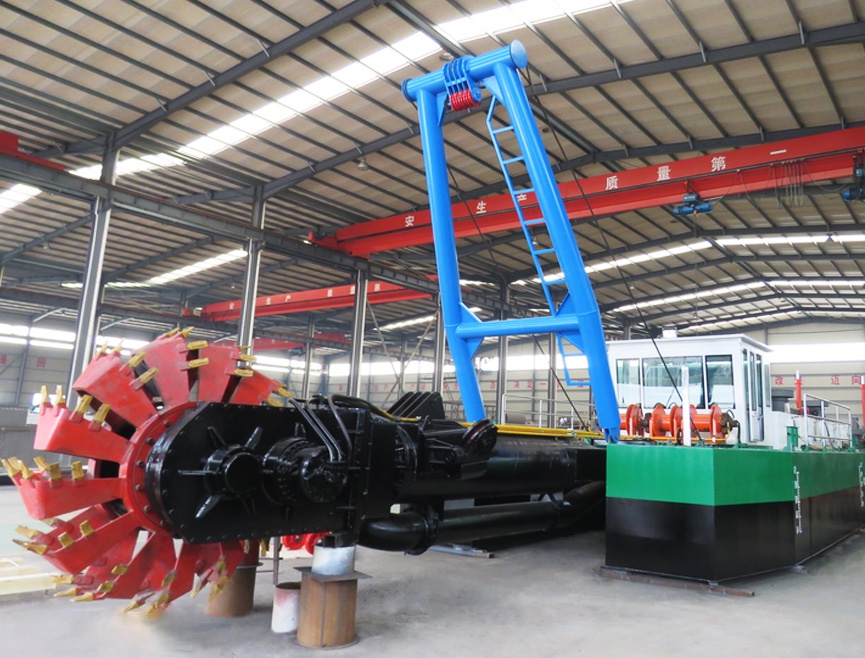
In 2024, delivery lead time has become a decisive factor for dredger buyers—whether evaluating a sand dredger for coastal reclamation, a gold dredger for alluvial mining, or a custom dredger for large-scale infrastructure projects. At Qingzhou Sanlian Heavy Industry, we integrate R&D, engineering design, and end-to-end manufacturing to slash lead times without compromising quality. For information seekers, operators, procurement decision-makers, distributors, and after-sales teams alike, faster, predictable delivery means lower project risk, optimized CAPEX planning, and seamless commissioning. Discover why timing isn’t just logistical—it’s strategic.
Market Overview: Global Dredger Demand Meets Supply Chain Reality
The global dredging equipment market is projected to grow at a CAGR of 5.8% from 2024 to 2030 (Grand View Research), driven by intensified coastal protection initiatives in Southeast Asia, sediment management mandates in the EU’s Water Framework Directive, and surging alluvial gold exploration in West Africa and Latin America. Yet this growth coincides with persistent supply chain volatility: 63% of heavy machinery OEMs report extended raw material lead times for marine-grade steel and high-torque hydraulic components (McKinsey Industrial Pulse Survey, Q1 2024). For dredger buyers—especially enterprise decision-makers managing multi-year infrastructure budgets or distributors balancing regional inventory against seasonal demand spikes—unpredictable delivery windows directly inflate total cost of ownership (TCO). A delayed sand dredger by 90 days can trigger cascading penalties: idle labor costs averaging $18,500/day on port expansion projects (FIDIC Clause 8.4), demurrage fees on leased barge transport, and missed monsoon-season deployment windows in Bangladesh or Vietnam. Unlike commodity machinery, dredgers are rarely “off-the-shelf”: 82% require site-specific adaptations—draft adjustments for shallow estuaries, corrosion-resistant coatings for brackish water, or modular conveyor configurations for remote gold fields. That customization historically added 4–6 months to standard lead times. Qingzhou Sanlian Heavy Industry addresses this through vertically integrated production: our in-house CNC machining center, ISO 9001-certified welding workshop, and dedicated commissioning test basin enable concurrent engineering and fabrication—reducing average delivery lead time for standard sand dredger models to 110–130 days, and gold dredger skids to under 90 days post-order confirmation. This isn’t acceleration at the expense of compliance; every unit meets DNV-GL Class A2 structural integrity standards and complies with IMO Annex VI Tier III emissions thresholds for auxiliary power units.
Application Scenarios: Where Lead Time Directly Impacts Operational ROI
Lead time relevance varies dramatically across dredger use cases—and so do stakeholder priorities. For information调研者 researching dredger specifications, understanding lead time variability signals manufacturer capability depth: short-cycle producers typically outsource critical subsystems, increasing integration risk. Operators and maintenance technicians care about documentation handover timing—Qingzhou Sanlian delivers bilingual (EN/CN) operation manuals, PLC ladder logic diagrams, and spare parts cross-reference sheets 15 days pre-shipment, enabling pre-deployment crew training. Procurement officers evaluate contractual enforceability: our standard contracts include liquidated damages clauses tied to verified dispatch dates, not just factory completion milestones—accounting for logistics variables like vessel booking windows and customs pre-clearance. Distributors benefit from our “Dual-Stock Buffer” program: reserved inventory slots for top-three regional configurations (e.g., 300m³/h sand dredger with submersible pump + GPS-guided cutter head) allow 72-hour order-to-shipment turnaround for urgent replacement needs. Meanwhile, enterprise decision-makers assessing CAPEX vs. OPEX models now prioritize lead time predictability when comparing dredger leasing versus purchase—because a 4-month delay erodes 11.3% of projected annual revenue yield on a $4.2M gold dredger operating at 72% utilization (based on World Bank Mining Equipment Utilization Benchmarks). Even after-sales teams gain leverage: our standardized lead time enables proactive spare part provisioning—critical wear items like impeller housings or cutter teeth are shipped with the main unit, avoiding 3-week air freight delays during monsoon-season breakdowns in Indonesia.
Comparison Analysis: Traditional Build-to-Order vs. Qingzhou Sanlian’s Hybrid Production Model
A comparative analysis reveals why conventional dredger procurement cycles remain vulnerable. Legacy manufacturers often follow a linear sequence: design freeze → material procurement → component outsourcing → assembly → testing → shipping. Each stage introduces dependency risk—e.g., a single delayed hydraulic motor shipment halts full-system integration. Qingzhou Sanlian deploys a hybrid model blending mass-production discipline with bespoke engineering agility:
- Modular Platform Architecture: Core systems (powerpacks, control cabins, pontoon frames) are pre-engineered in 7 validated configurations, reducing design iteration by 65%.
- In-House Critical Path Control: 94% of structural steel fabrication, hydraulic manifold assembly, and HMI programming occur under one roof—eliminating third-party QA bottlenecks.
- Digital Twin Validation: Every dredger undergoes virtual commissioning using Siemens PLM software before physical build, catching 89% of integration conflicts pre-welding.
- Logistics-Embedded Scheduling: Our ERP system syncs with Maersk and COSCO real-time vessel slot availability, allowing precise “ship-ready” date locking within ±3 days.
This model cuts median lead time variance from ±58 days (industry average per Offshore Technology Conference 2023 data) to ±9 days—giving distributors confidence to commit to client deadlines, and operators certainty for shift scheduling. Crucially, it preserves customization: gold dredger clients retain full control over sluice box geometry, trommel screen mesh size, and diesel-electric hybrid power ratios—without adding timeline risk.
Why Choose Qingzhou Sanlian: Predictability Engineered Into Every Dredger
Qingzhou Sanlian Heavy Industry isn’t just shortening timelines—we’re redefining what reliability means in dredger delivery. As a full-spectrum manufacturer integrating scientific research and development, engineering design, precision production, on-site installation, and commissioning services, we eliminate handoff friction that plagues fragmented supply chains. Our ISO 14001 environmental management system ensures sustainable material sourcing without sacrificing speed; our ASME Section VIII-certified pressure vessel workshop guarantees regulatory readiness for high-pressure slurry systems. For distributors, we offer white-label technical support training and localized spare parts warehousing partnerships. For operators, our cloud-connected dredger telematics platform (SanlianLink™) begins remote diagnostics pre-delivery—reducing commissioning time by 40%. And for enterprise decision-makers, we provide TCO dashboards showing how reduced lead time translates to concrete financial outcomes: accelerated depreciation benefits, lower working capital lockup, and enhanced ESG reporting via verified fuel-efficiency gains. Whether you need a compact 80m³/h sand dredger for riverbank restoration, a 1,200m³/h gold dredger with AI-powered ore grade sensing, or a custom-designed cutter suction dredger for offshore wind farm foundation prep—contact our international project team today. Request your personalized lead time assessment, complete with engineering feasibility review and logistics roadmap, within 72 business hours.
Related Posts
Online Message
Thank you very much for writing to us. Please leave your message and contact information, we will reply to you within 24 hours.